What Is Stem Separation A Beginners Guide
- 29 Jul 2026
- 09:51
If you've spent even a little time watching music production videos or exploring AI audio tools, you've probably heard people talk about stem separation. Producers mention it while building remixes, DJs use it during mashups, and creators often recommend it when explaining how they isolated vocals from a song.
The funny thing is that almost everyone uses the term, but very few stop to explain what it actually means.
For many beginners, it sounds like something reserved for professional studios. The word stem itself doesn't tell you much unless you've already worked with music production software. That's probably why so many people search for questions like "What is stem separation?" or "How does stem separation work?" before they try any of the available tools.
The idea, however, is much simpler than the name suggests.
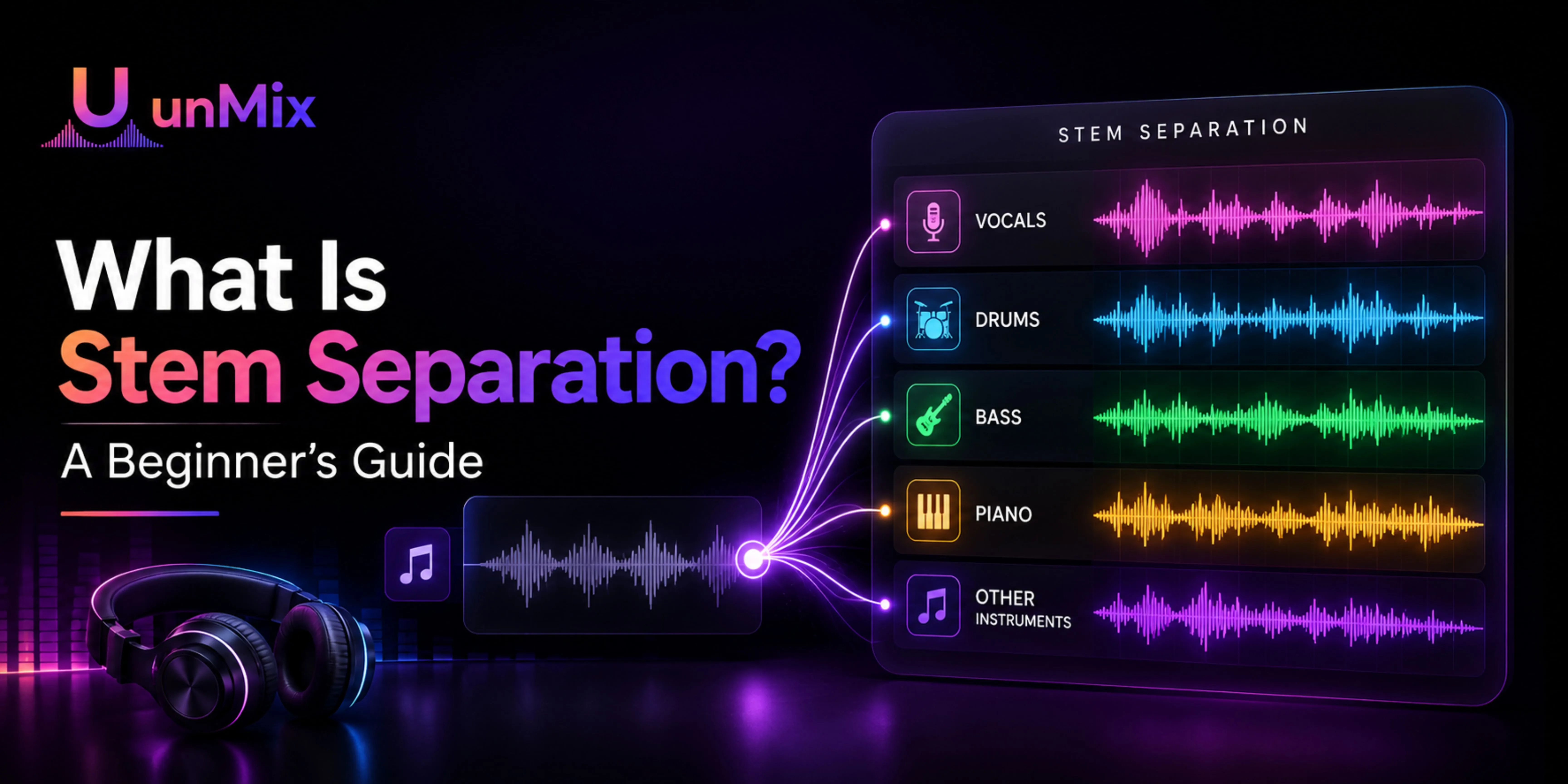
“Stem separation is the process of splitting a finished song into separate audio parts, often called stems. Instead of hearing one mixed track, you can isolate vocals, drums, bass, piano, guitars, or other instruments so each element can be used on its own.”
Years ago, doing this required access to the original studio recordings or expensive editing software. Today, AI stem separation has made the process far more accessible. Whether you're a musician practising a song, a DJ creating a mashup, or someone who simply wants an instrumental version of a favourite track, separating music has become something almost anyone can do.
The technology is impressive, but what's really changed is accessibility. Tasks that once belonged almost exclusively to recording studios are now available to students, creators, teachers, and hobbyists with nothing more than a browser or a mobile app.
Understanding Stem Separation Without the Technical Jargon
Before talking about AI, it helps to understand what a stem actually is.
Imagine a band recording a song in a studio. The singer records the vocals. The drummer records the drum parts. The guitarist, bassist, keyboard player, and everyone else records their own performance separately. During production, those recordings are carefully mixed together until they sound like the song everyone eventually hears on Spotify or YouTube.
Once the mix is finished, those individual recordings disappear behind a single audio file.
That's where stem separation becomes useful.
Instead of treating the song as one piece of audio, modern software analyses the finished recording and separates it into multiple layers that closely represent the original parts. Rather than working with one combined track, you suddenly have access to vocals, instrumentals, drums, bass, and other musical elements individually.
One thing that's worth mentioning is that these aren't always the original studio stems. Unless you have access to the project's recording session, no software can magically recover files that no longer exist. What modern stem separation software does is analyse the completed song and recreate those layers with remarkable accuracy.
For most people, that distinction isn't particularly important.
If the isolated vocals sound clean enough for a remix, or the instrumental works perfectly for karaoke practice, the technology has already done exactly what it was supposed to do.
Why Has Stem Separation Suddenly Become So Popular?
A few years ago, most people searching for vocal removal had one goal in mind: creating karaoke tracks.
That hasn't disappeared, but the audience has become much broader.
Stem separation is something that you might not expect to be employed today. It allows music tutors to separate instruments for the purpose of teaching students the arrangement's individual aspects. Producers separate older songs before creating their remix versions. Content creators separate vocals so as to make their own versions of background music. Singers make use of practice tracks from stems without requiring the actual instrumental track. The DJs take advantage of separated vocals to produce mashups.
The interesting part of this technology is the fact that all of these people are employing the same technology in totally different ways.
The development of artificial intelligence plays a significant role in making this possible. The earlier forms of the process involved a lot of editing that required patience, skill, and user-unfriendly software. The results could be quite variable as well. Separating the vocals would usually affect the entire song negatively, making an echo or distorting instrumentals.
Modern AI music separation approaches the problem differently. Instead of asking users to edit waveforms or experiment with frequency settings, the software does most of the heavy lifting automatically. Upload the song, wait a few moments, and review the separated stems.
That's probably the biggest reason stem separation has moved beyond professional studios. It isn't just more accurate than it used to be—it's dramatically easier to use.
How Does Stem Separation Actually Work?
This is usually the question people ask next.
If software can separate a finished song into individual parts, what's actually happening behind the scenes?
The answer isn't magic, although it can feel like it the first time you hear the results.
Older vocal removal tools mostly relied on frequency filtering. Since the human voice occupies a certain frequency range, the software attempted to reduce those frequencies to remove the singer. The problem was that instruments often shared many of those same frequencies. As a result, the vocals disappeared—but so did parts of the piano, guitar, or other instruments.
That's why older karaoke tracks often sounded thin or unnatural.
Modern AI stem separation works differently.
Instead of looking only at frequencies, AI studies patterns. After being trained using millions of music samples, it gradually learns how vocals behave compared to drums, bass, guitars, and other instruments. When you upload a song, the system analyses the entire recording instead of focusing on one narrow part of the audio.
It looks for relationships between sounds, predicts which elements belong together, and separates them into individual stems that can be played or downloaded independently.
You don't need to understand the underlying algorithms to benefit from the technology.
What matters is that today's results are cleaner, faster, and far more reliable than the techniques people relied on only a few years ago.
What Can You Actually Separate?
Most people discover stem separation because they want to remove vocals from a song. That's usually the first thing they try.
Then they realise there's a lot more they can do.
Depending on the tool you're using, a single song can often be split into several different stems. The most common ones include lead vocals, backing vocals, drums, bass, piano, guitar, and a combined instrumental track. Some advanced tools go even further, identifying strings, synthesizers, percussion, and other instruments separately.
The practical uses are surprisingly varied.
A singer preparing for a live performance can remove the original vocal and rehearse with the backing track. A producer might isolate the drum groove from an old recording to study how it was arranged. DJs regularly extract vocals to create mashups that blend songs from completely different genres. Even music teachers use isolated stems to help students hear details that are often buried inside a full mix.
You don't have to be making commercial music to find it useful, either.
Someone learning guitar can mute everything except the rhythm section to practise timing. A podcaster might remove vocals from a licensed backing track before adding narration. Video creators often isolate instrumentals to make background music less distracting without changing the feel of the original song.
The technology hasn't changed the way music is recorded.
It's changed what people can do with music after it's already been released.
So, Is Stem Separation Always Perfect?
It would be nice if every song could be separated flawlessly.
Reality is a little more complicated.
The quality of the output depends largely on the recording you're starting with. A clean studio master generally produces excellent results because every instrument is already well balanced. Older recordings, heavily compressed MP3s, or songs packed with layered effects naturally present a tougher challenge.
Think about a modern pop chorus.
There might be a lead vocal, several harmony layers, multiple synthesizers, guitars, drums, bass, sound effects, and reverb—all playing at the same time. Those sounds overlap constantly, which makes separating them more difficult than isolating vocals from a simple acoustic performance.
That doesn't mean AI fails. It simply means some songs ask more of it than others.
Fortunately, stem separation has improved dramatically over the past few years. Earlier software often left behind robotic echoes or noticeable artefacts after removing vocals. Today's AI models analyse far more than simple frequencies, producing cleaner and more natural-sounding stems that are suitable for remixing, practice sessions, karaoke, content creation, and many production workflows.
If you're expecting the original studio multi tracks, you'll probably be disappointed.
If you're expecting clean, usable stems from a finished song, modern AI usually delivers exactly that.
How to Choose the Right Stem Separation Software
A quick search for "stem separation software" will give you numerous choices.
There are applications designed for professional producers who spend many hours working within digital audio workstations. There are other tools intended for those who would like to upload their song, separate stems and download the results after some time.
Neither one solution is better than the other one.
Choosing one or another solution depends on your specific needs.
Those who are creating remixes need more detailed possibilities for editing of separate stems and exporting the results. For a music teacher clarity of the audio can be more important than any other option. Singers usually prefer to get the job done fast and easy as they just need a clean track for training.
Instead of comparing the number of functions that each software has, let's take into consideration some other things.
Is it providing clean separations?
Is it able to process standard audio files without any additional steps?
Is it simple enough to start working with it right away?
Those questions usually matter far more than whether a tool offers dozens of advanced controls you'll never use.
For anyone looking for a simple starting point, unMix takes a straightforward approach. Upload your audio, let the AI process the recording, preview the separated stems, and download only the tracks you need. Whether you're extracting vocals, creating an instrumental, or exploring individual stems for the first time, the process stays approachable without sacrificing audio quality.
Good software should help you focus on creating—not on figuring out how the software itself works.
Final Thoughts
A few years ago, stem separation felt like something reserved for recording studios and professional engineers.
Today, it's becoming part of everyday music creation.
The biggest reason isn't that the technology suddenly became more powerful. It's that it became easier to use.
People no longer need access to expensive equipment or years of production experience just to experiment with isolated vocals or instrumentals. Whether you're practising a song, building a remix, analysing an arrangement, or creating content for social media, stem separation gives you access to parts of a recording that once felt completely out of reach.
And that's probably why the term keeps appearing everywhere.
As AI continues to improve, separating music is becoming less about technical knowledge and more about creativity. The tools are doing more of the heavy lifting, leaving users free to focus on what they actually want to make.
If you've never tried stem separation before, the easiest way to understand it isn't by reading another explanation.
Upload a song, separate the stems, and listen to each layer on its own.
The first time you hear a vocal standing completely on its own—or a drum pattern you never noticed inside the original mix—you'll understand why this technology has become such an important part of modern music.