Lead Vocals
Isabella

Alto Saxophone
Marcus

Lead Guitarist
Ravi

The Beatmaker
Tyler

Keyboards & Synth
Helena

Bassist
Elijah

Electric Violin
Sophie
Music Lessons for Singers,
Musicians & Creators
- Learn singing, instruments, and music creation with AI
Chapter 1: Songwriting Foundations
Finding Song Ideas
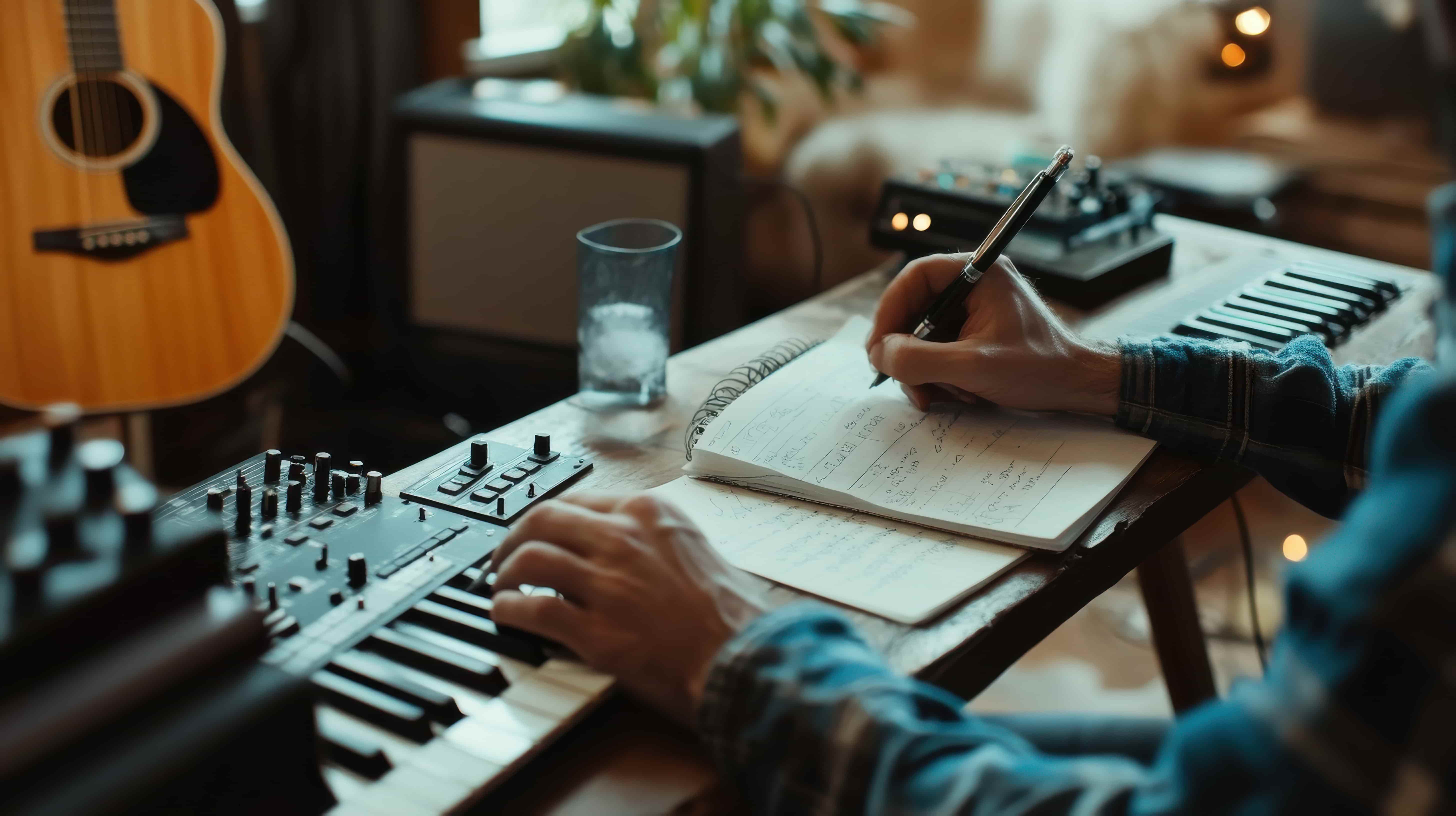
Ideas usually hide in ordinary moments. A line your friend said. A memory you keep returning to. A feeling you can’t shake off. Good songwriting starts with noticing things others overlook.
Try these simple sparks:
• One strong emotion (joy, regret, longing)
• A single visual (rain, headlights, empty room)
• A real conversation
• A “what if” scenario
Tip: record tiny ideas in your phone. Most hit songs began as messy one-liners.
Writing Honest Lyrics
Honesty lands harder than complicated poetry. Listeners connect to lyrics that feel lived-in, not perfect.
Keep it clean and focused:
• Use simple words — they travel further
• Write as you speak — it feels real
• Describe small details — they feel personal
Example: “I miss you” is generic.
“I kept your coffee mug on the table for days” is a story.
Building a Song Step-by-Step
Think of a song like a house.
1. Foundation: core emotion + message
2. Structure: verse (story), chorus (emotion), bridge (twist)
3. Melody: how your message flows
4. Lyrics: fitting words to the rhythm
5. Production: color and atmosphere
A song becomes strong when each layer supports the others. You don’t need to build everything at once — many great songs started as one repeated line.
Turning Emotion into Melody
Melodies are emotions turned into patterns.
• Happy emotions → upward jumps, faster rhythm
• Sad emotions → longer notes, slower movement
• Tension → unexpected twists
• Calmness → smooth, step-by-step motion
Your voice naturally expresses emotion — record yourself humming without words. The best melodies often appear before you start “thinking.”
Once you isolate vocals or instrumentals with unMix, hum along and feel where your voice naturally moves. That’s your melodic instinct speaking.